


Photocopier Lease Costs for Business: 2026 Guide
Is the lowest monthly quote on your desk actually the most expensive mistake your office will make this year? It’s a question many business owners forget to ask whilst comparing photocopier lease costs for business in an increasingly complex market. It’s natural to feel a bit of trepidation about being locked into an inflexible five-year contract, especially when the fine print regarding cost-per-page rates and hidden maintenance fees remains blurry. You want a reliable machine that just works, but the fear of unexpected toner bills or part replacements often makes the decision feel like a significant gamble.
We believe that equipment procurement should be built on honesty and long-term value. This 2026 guide strips away the industry jargon to help you accurately calculate your total leasing expenses and choose the most tax-efficient path for your office. We’ll provide a clear breakdown of monthly costs and show you how to secure a service agreement that covers everything from toners to technical support. By the end of this article, you’ll have the no-nonsense insights needed to make a confident, informed choice for your business’s future.
Table of Contents
Understanding Photocopier Lease Costs: The Fundamentals
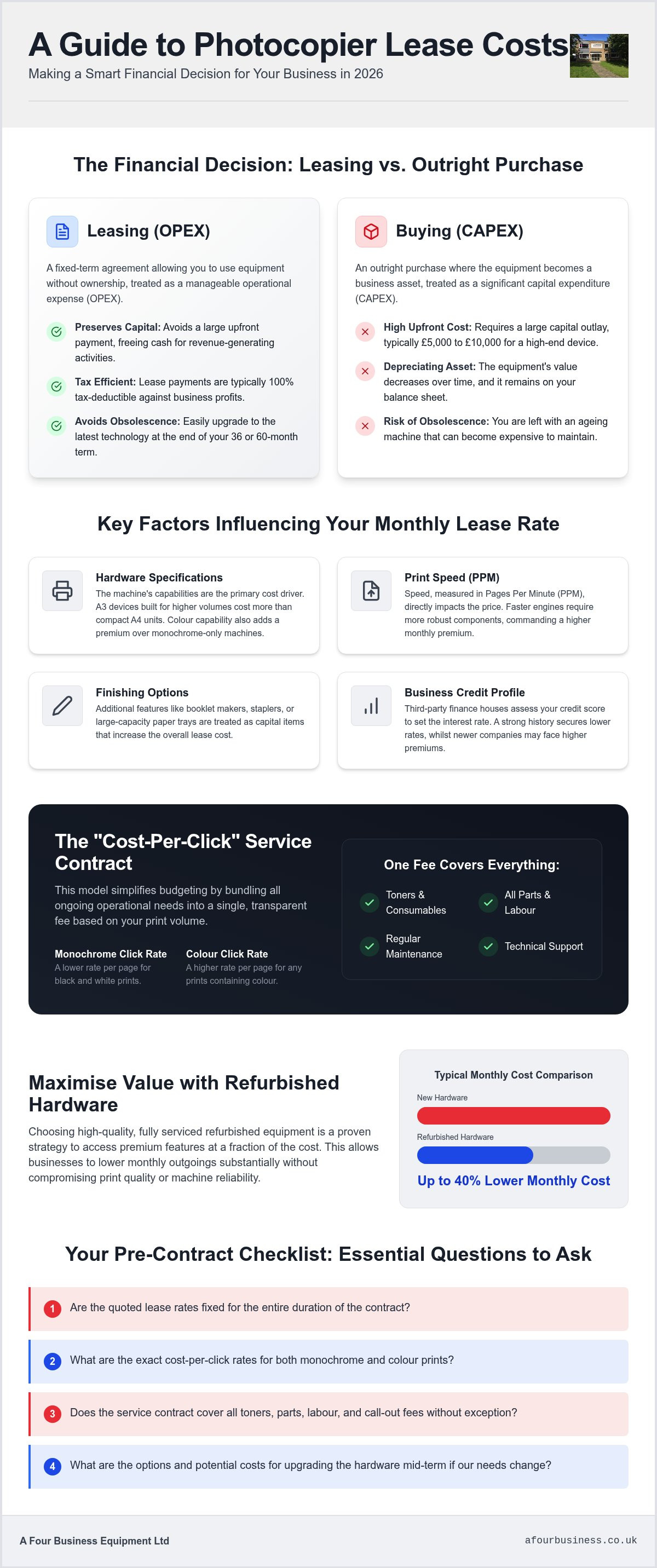
A photocopier lease is essentially a fixed-term agreement that allows your office to use high-specification equipment without the burden of ownership. Instead of paying a large sum upfront, you pay a regular monthly or quarterly fee over a set period. Understanding Lease Agreements is the first step toward making a sensible financial choice. It shifts the focus from a heavy capital investment to a manageable operational expense. Most UK businesses prefer this route because it preserves vital cash flow, allowing capital to be spent on revenue-generating activities rather than depreciating office kit.
In a business context, you'll typically encounter two types of agreements: Finance Leases and Operating Leases. A Finance Lease often appears on your balance sheet and may offer an option to own the machine at the end of the term. An Operating Lease is more common for technology that dates quickly. It keeps the equipment off your balance sheet and makes it easier to refresh your tech every few years. For the 2026 tax year, leasing remains a highly efficient strategy. Payments are generally 100% tax-deductible against your business profits, which can significantly lower the real-term photocopier lease costs for business compared to buying outright.
Leasing vs Buying: The Financial Comparison
The choice between upfront capital expenditure (CAPEX) and monthly operational costs (OPEX) is often decided by your growth plans. Buying a high-end multifunctional device might cost £5,000 to £10,000. That's a significant drain on resources. Leasing allows you to install a much higher-specification machine than you might otherwise afford, providing your team with faster print speeds and better finishing options from day one. It also solves the problem of obsolescence. When the lease ends, you simply upgrade to the latest model rather than being stuck with an ageing machine that's expensive to maintain.
Typical Lease Terms for UK Businesses
Standard lease durations in the UK are usually 36 or 60 months. A longer 60-month term will naturally result in lower monthly repayments, which is helpful for tight budgets. However, a 36-month term offers more agility, letting you move to newer technology sooner. It's also worth checking the flexibility of your agreement. Many providers offer "mid-term refreshes," where you can upgrade your hardware before the original contract ends if your print volumes increase or your business expands. This ensures your office equipment always matches your current needs without a massive financial penalty.
Key Variables That Influence Your Monthly Lease Rate
The total photocopier lease costs for business aren't plucked from thin air. They're a precise calculation based on the machine's capital value and the perceived risk of the lending. Understanding these variables helps you avoid over-specifying a machine you don't need or, conversely, under-specifying one that will struggle with your daily workload. It's about finding a balance between the functionality your team requires and the budget your finance department has set.
Hardware Specifications and Cost Brackets
The physical footprint of the machine is your starting point. A compact A4 desktop unit is naturally more affordable than a floor-standing A3 device. However, A3 machines are built for higher volumes and typically have longer lifespans. You also need to consider the colour element. A colour-capable machine typically carries a higher lease profile than a monochrome-only unit because the hardware itself is more complex. The speed of the device, measured in pages per minute (PPM), acts as a primary lever for the base lease price; faster engines require more robust internal components and therefore command a higher monthly premium. If you add finishing options like booklet makers, large-capacity paper trays, or staplers, these are treated as additional capital items that increase the overall lease base. For many UK firms, choosing high-quality used hardware provides a way to get production-level features at a significantly lower monthly rate.
The Role of Finance Houses and Credit
Most photocopier suppliers don't actually lend you the money themselves. Instead, they partner with specialist finance houses. These third-party lenders review your business credit score to determine the interest rate, which can noticeably shift the final photocopier lease costs for business. A strong credit history usually secures a lower rate, whilst newer companies might face higher premiums or require a director's guarantee for approval. To get the green light, you'll typically need to provide recent audited accounts or bank statements to prove your stability. This process is standard, but it pays to be prepared with your documentation. Following an SBA Guide to Equipment Leasing can help you understand the broader principles of financing, even if you're operating here in the UK. When choosing your term, remember that shorter leases of 36 months are often better for high-growth companies. They allow you to scale your technology more frequently, even if the monthly payment is slightly higher than a 60-month agreement.
The Service Contract: Cost-Per-Click and Consumables
Signing a lease agreement is only half of the equation. To keep your office running smoothly, you need a robust service contract. This agreement ensures that your photocopier lease costs for business remain predictable, even when hardware fails or toners run dry. Without a service plan, a single broken fuser unit or an empty cyan cartridge could result in significant downtime and unexpected repair bills. A professional service contract essentially acts as an insurance policy for your productivity. It keeps your team focused on their work rather than troubleshooting hardware.
The core of most modern agreements is the "Cost-Per-Click" (CPC) model. Under this system, you pay a fixed rate for every page that passes through the machine. This fee covers all the maintenance and parts needed to keep the device functional. It's a transparent way to manage expenses because your costs scale naturally with your office activity. Many businesses find that following the SBA's guide to equipment leasing helps them understand how these service-linked operating leases work in practice, ensuring they don't overlook the importance of maintenance clauses when assessing total photocopier lease costs for business.
What is Included in a Professional Service Agreement?
A comprehensive agreement should cover all maintenance, emergency repairs, and replacement parts. This includes everything from the drums and rollers to the toner itself. The only items you're typically expected to provide are paper and staples. Beyond the physical parts, the most valuable element is the engineer's response time. If your machine stops working, you need a guarantee that a technician will be on-site within a few hours to resolve the issue. Preventative maintenance is also a key feature; regular servicing catches minor wear and tear before it evolves into a major breakdown that halts your operations. We've seen that consistent care extends the machine's life significantly.
Calculating Your Total Monthly Bill
Your total monthly invoice is usually calculated using a simple three-part formula: the base lease payment for the hardware, a small service fee, and the variable click charge based on your monthly volume. It's vital to monitor your mono versus colour print mix, as colour clicks are significantly more expensive. You should also keep a keen eye out for "minimum billing" clauses. These traps force you to pay for a set number of pages even if your actual usage is lower. A Managed Service Contract is usually cheaper than ad-hoc repairs because the fixed monthly fee incentivises the provider to keep your machine in peak condition through regular preventative care.
Maximising Value: The Case for High-Quality Used Photocopiers
Slashing overheads is a priority for most UK firms. Whilst many assume that a brand-new machine is the only way to ensure reliability, high-quality refurbished hardware often provides a more strategic path to reducing photocopier lease costs for business. These machines are typically "off-lease" units from major corporations that have been meticulously maintained throughout their initial term. By choosing a refurbished model, you can often secure a high-performance machine for a fraction of the monthly rate of a new equivalent. It’s a practical, no-nonsense approach to office procurement that doesn't compromise on the quality of your printed documents.
There’s also a significant environmental argument to consider. Extending the life of premium hardware reduces the demand for new manufacturing and prevents perfectly functional machines from becoming e-waste prematurely. For businesses with a commitment to sustainability, leasing a refurbished device is an ethical choice that aligns with modern corporate social responsibility goals. You aren't just saving money; you're participating in a circular economy that values durability and professional craftsmanship over the "throwaway" culture of cheaper, entry-level printers.
New vs Refurbished: A Direct Comparison
The financial gap between new and used kit is often substantial. Research indicates that refurbished hardware can be available at a 30 to 50 percent discount compared to new equipment. This allows a business to lease a high-end, floor-standing MFD with advanced finishing options for the same price as a basic, mid-range new model. Used machines are particularly ideal for secondary offices, satellite departments, or environments where the print volume is steady but doesn't require the absolute latest software features. The reliability myth is easily dispelled by the fact that high-end commercial copiers are built to produce millions of pages; a machine with a few hundred thousand clicks is only just getting started.
Service Support for Used Hardware
Reliability is built on maintenance, not just the age of the machine. When you lease used hardware through a reputable provider, your service contract should be identical to that of a new machine. This includes the same engineer response times, the same inclusion of toners and parts, and the same commitment to business continuity. At A Four Business Equipment Ltd, we’ve spent nearly 40 years selecting and preparing used stock for national supply. Every unit undergoes a rigorous multi-point inspection and parts refresh before it reaches your office. This ensures your equipment performs with "as-new" consistency from the moment it's installed. To see our current range of reliable, cost-effective hardware, view our high-quality used photocopiers here.
Securing the Right Deal: Questions to Ask Your Supplier
Finalising your agreement requires a keen eye for detail. The headline figure you see on a quote often hides the true photocopier lease costs for business if you don't ask the right questions upfront. You need to know if the lease price is fixed for the entire duration or if the supplier includes annual price adjustments or escalations. It’s common for some providers to bake in an annual increase, which can drastically alter your budget by the fourth or fifth year of the term. Transparency at this stage prevents any nasty surprises further down the line.
Ask specifically about the terms for upgrading or ending the lease early. Business needs change, and you don't want to be trapped in a contract that doesn't allow for growth. You should also demand a clear answer on hidden costs. These often include one-time admin fees or delivery and setup charges that weren't mentioned in the initial discussion. A professional service agreement must also include a guaranteed response time for repairs. Without this, your office could be at a standstill for days whilst waiting for an engineer to arrive.
Vetting Your National Supplier
Longevity is the best indicator of reliability in this industry. Working with an established firm, such as one founded in 1988, offers a level of security that newer brokers simply cannot match. You aren't just looking for a machine; you're looking for a partner that will still be there to provide toners and technical support in five years. Seek total transparency in the small print of both the lease and the service documents. A reputable national supplier will be happy to explain every clause and demonstrate their ability to maintain your equipment across all your sites with a consistent level of care and professional pride.
Finalising Your Office Document Strategy
Before signing anything, conduct a thorough print audit. This simple step ensures you aren't over-specifying your device and paying for capacity you'll never use. Remember that the health of your machine also depends on the quality of the consumables you use. Using high-quality toners and paper prevents the internal wear and tear that leads to frequent breakdowns and costly downtime. If you're ready to secure a deal built on honesty and decades of expertise, your next step is simple. You can request a transparent lease quote from A Four Business Equipment Ltd today to see exactly how we can support your office's growth with a reliable, tax-efficient solution.
Empower Your Office with a Transparent Print Strategy
Navigating the complexities of office hardware doesn't have to be a daunting task. By focusing on total cost of ownership rather than just the headline rate, you can avoid common pitfalls like inflexible contracts and hidden fees. A successful agreement balances the right hardware specification with a robust service contract that covers your toners and maintenance. Whether you opt for the latest multifunctional technology or choose the significant savings offered by high-quality used devices, your priority should always be long-term reliability. Gaining a clear view of photocopier lease costs for business is the first step toward a more predictable office budget.
As expert business equipment specialists since 1988, A Four Business Equipment Ltd provides full national service and maintenance coverage alongside a comprehensive range of new and refurbished devices. We're here to act as your trusted advisor. We'll ensure your equipment supports your growth rather than hindering your cash flow. Get a transparent, no-nonsense photocopier lease quote today and take the first step toward a more efficient office. We look forward to supporting your business.
Frequently Asked Questions
Is it better to lease or buy a photocopier for a small business?
Leasing is often the more sensible choice for small businesses because it avoids a large upfront capital outlay. It allows you to keep your cash in the bank for operational needs whilst benefiting from modern technology. Additionally, lease payments are typically 100% tax-deductible as a business expense. Buying outright might be cheaper over the long term, but it ties up capital and leaves you responsible for disposing of ageing hardware.
How much does it typically cost to lease an office photocopier per month?
Monthly photocopier lease costs for business typically range from £125 to £450 for a mid-range colour multifunctional device. The final figure depends on the machine's specification, your monthly print volume, and your business credit score. High-volume production machines or those with advanced finishing options like booklet makers will naturally command a higher premium. It’s always best to request a tailored quote to see how these variables affect your specific monthly budget.
What happens at the end of a photocopier lease term?
At the end of your term, you usually have three main options: upgrade to a newer model, return the equipment, or extend the lease at a reduced rate. Most UK firms choose to upgrade, as this ensures their office always has access to the latest energy-efficient technology and security features. It’s important to check your contract’s notice period, as many lenders require written notice several months before the agreement expires to avoid automatic extensions.
Can I lease a used or refurbished photocopier to save money?
You can certainly lease a refurbished machine to reduce your overheads. Choosing high-quality used hardware can lower your monthly lease rates by 30% to 50% compared to brand-new models. At A Four Business Equipment Ltd, we specialise in supplying refurbished units that undergo a rigorous multi-point inspection. These machines offer the same professional print quality and reliability as new devices, making them an excellent choice for cost-conscious businesses across the country.
Are photocopier lease payments tax-deductible for UK companies?
Yes, lease payments are generally 100% tax-deductible for UK companies against their annual profits. Because leasing is classified as an operating expense (OPEX) rather than a capital investment (CAPEX), you can often offset the full cost of the rentals. This provides a significant advantage over buying, where you might only be able to claim capital allowances on a portion of the purchase price. We always recommend consulting your accountant for specific advice regarding the 2026 tax year.
What is a cost-per-click (CPC) agreement and how does it work?
A cost-per-click (CPC) agreement is a service model where you pay a fixed fee for every page you print or copy. This single "click" charge covers all your maintenance, emergency repairs, and replacement parts. It also includes the delivery of toners and drums, ensuring you never face a large, unexpected bill for consumables. It’s a transparent way to manage your printing budget, as you only pay for the actual volume your office produces each month.
What hidden costs should I look out for in a leasing contract?
You should look out for one-time administration fees, delivery charges, and annual price escalations. Some suppliers include a clause that allows them to increase your service or lease rates by a set percentage each year. Other potential hidden costs include "minimum billing" traps, where you're charged for a set number of pages even if you don't print them. Always review the small print to ensure the headline photocopier lease costs for business remain fixed and fair.
Does the lease include toner and maintenance support?
Most professional leases include toner and maintenance support when bundled with a service agreement. This comprehensive coverage ensures that an engineer will attend your site if the machine fails and that replacement toners are delivered automatically before you run out. At A Four Business Equipment Ltd, we include full-service maintenance contracts in our solutions. This means your parts, toners, and labour are all covered, providing you with total peace of mind and business continuity.


Comments